


What Is microSD Express? Why Nintendo Switch 2 Needs This Next-Gen Memory Card
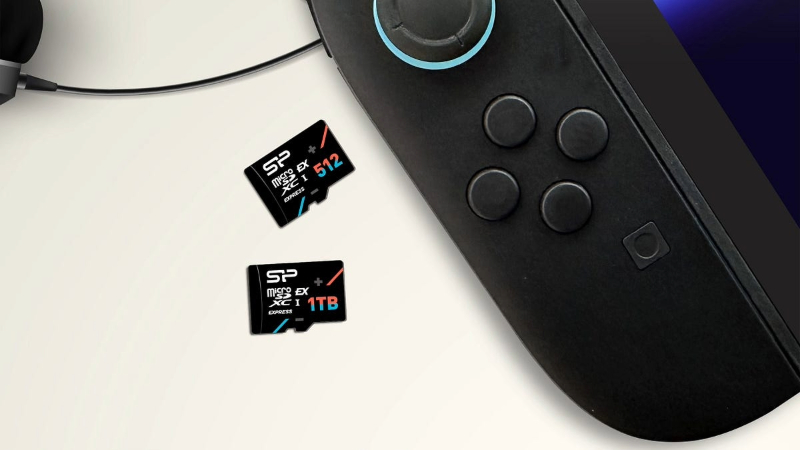
What exactly is microSD Express? How is it different from a regular microSD card?
With the release of the Switch 2, Nintendo has required players to use microSD Express memory cards for storage expansion, making it a highly discussed topic. But what exactly is microSD Express, and how does it differ from standard microSD cards? The SD Association introduced the microSD Express specification back in 2019. By utilizing PCIe channels, these cards now achieve transfer speeds exceeding 800MB/s, which is roughly ten times faster than traditional UHS-I memory cards. Curious about why microSD Express is so fast and where it can be used? This article explores the specifications and applications of microSD Express in detail.
Menu
-What is microSD Express? How does it differ from standard microSD?
What is microSD Express? How does it differ from standard microSD?
microSD Express is a memory card standard introduced by the SD Association in 2019. Built on the SD 7.1 specification, it was designed to meet the growing need for high-speed data transfer and demanding applications. Unlike traditional microSD cards, microSD Express replaces the standard UHS-I interface with a PCIe interface and uses the NVMe protocol, offering performance similar to solid-state drives. In theory, it can reach maximum transfer speeds of up to 985MB/s, far exceeding the 104MB/s limit of UHS-I cards and marking a significant leap in speed.
MicroSD Express cards are also easy to recognize thanks to a unique logo. While traditional microSD cards display a simple icon, microSD Express cards feature an added “EX” designation to indicate their advanced capabilities.
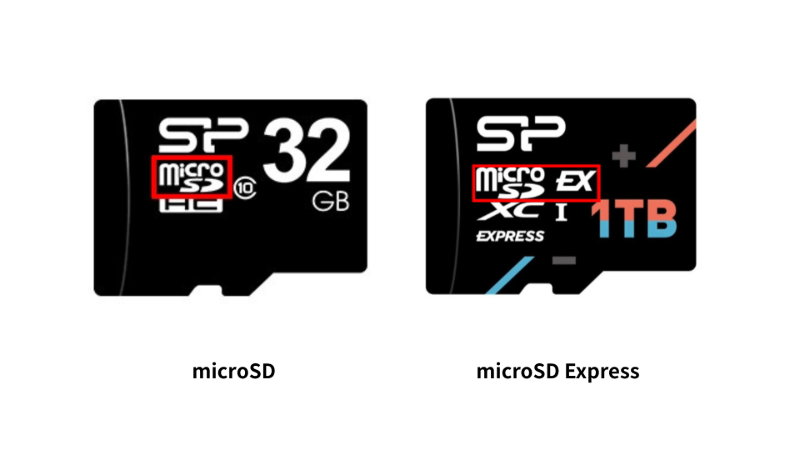
Compared to the microSD icon, microSD Express features an additional "EX" mark.
The following sections will explore the main features of microSD Express, including interface design, speed advantages, and device compatibility.
microSD Express Interface
The high performance of microSD Express comes from its use of the PCIe 3.1 interface combined with the NVMe 1.3 protocol. This setup not only boosts data transfer speeds but also improves resistance to electromagnetic interference, ensuring more stable connections. The NVMe protocol allows direct memory access, reducing power consumption and latency. Compared to traditional microSD cards using the UHS interface, microSD Express brings speed and performance closer to that of SSDs.
microSD Express Speed
Thanks to the PCIe 3.1 interface and NVMe 1.3 protocol, microSD Express can reach peak transfer speeds of up to 985MB/s. This far exceeds the maximum theoretical speeds of traditional microSD cards: UHS-I at 104MB/s, UHS-II at 312MB/s, and UHS-III at 624MB/s. Under the latest SD 9.1 specification, SD Express has been upgraded to support dual-lane PCIe 4.0. Although current microSD Express cards use single-lane PCIe 3.1, future versions could reach speeds approaching 2GB/s, dramatically improving data transfer efficiency for large files.
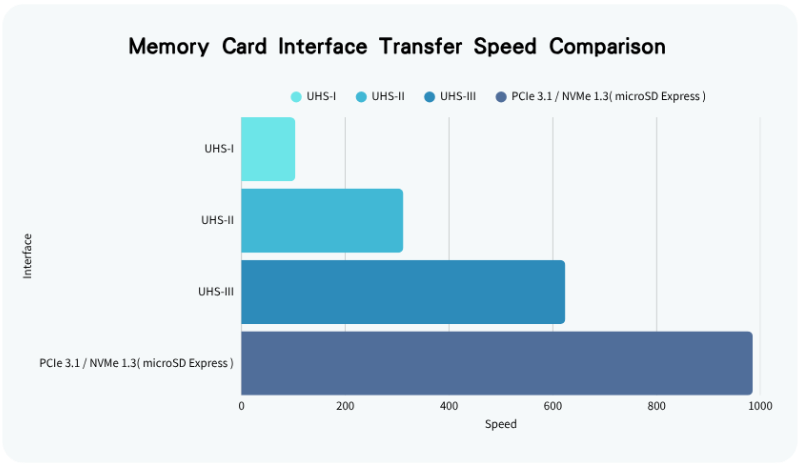
Speed comparison of UHS-I, UHS-II, UHS-III, and PCIe 3.1 / NVMe 1.3.
microSD Express Compatibility
microSD Express is backward compatible with devices using UHS-I, UHS-II, or UHS-III interfaces. However, because its pin signal definitions differ from the UHS series, performance will be limited to the speed of the corresponding UHS standard when used in non-compatible devices. To fully leverage the high-speed capabilities of microSD Express, it must be paired with a host device or card reader that supports the microSD Express standard.
microSD Express Applications
After reviewing microSD Express specifications, you might wonder where it is most useful. While dashcams and surveillance cameras do not need such high speeds, advanced devices, especially those with AI, gaming, or 4K/8K recording, benefit greatly from faster read and write performance. Here are three key use cases.
4K/8K Video Recording
For smooth 4K or 8K video recording, fast read and write speeds are essential. Adequate write speeds prevent stuttering or frame drops during continuous recording. If write speeds are too slow, recording may lag, skip frames, or even stop unexpectedly. MicroSD Express cards can offer write speeds between 500 and 700 MB/s, meeting the demands of high-resolution video recording.
Handheld Gaming Consoles (Switch 2)
With the launch of the Switch 2, Nintendo requires microSD Express cards for storage expansion. The upgraded hardware, including a display with up to 120Hz refresh rate and 4K/60fps output when connected to a TV, benefits greatly from high-speed memory. Faster read speeds reduce game loading times, minimize lag, and ensure smooth performance. Using microSD Express allows the Switch 2 to handle larger games more efficiently, providing a more enjoyable experience for players.
VR and AR Devices
VR and AR devices rely on rapid read and write speeds to deliver realistic, high-definition visuals. Slow memory performance can cause latency and stuttering, which reduces immersion. MicroSD Express cards allow these devices to handle large files such as 8K videos, 3D models, and 360-degree panoramic images. For applications requiring real-time rendering and high-resolution output, microSD Express ensures smooth visuals and maintains a natural, immersive experience.
Recommendations for microSD Express Card
After understanding microSD Express applications and fundamentals, choosing the right card is essential, especially if you own a Switch 2 or need to record 4K or 8K video. When selecting a card, focus on three key factors: read and write speeds, capacity, and durability.
For gaming, choose faster read speeds for smoother loading. For high-definition video, stable write speeds are essential. Pick a card with enough capacity to store large files and consider protection features like electrostatic and X-ray resistance and temperature tolerance for durability.
Here's a recommended microSD Express card ideal for gaming, video recording, and high-storage computing!
SP Hypera microSDXC™ Express Card
The SP Hypera microSDXC™ Express Card offers both high speed and large storage capacity. It delivers read speeds up to 880MB/s and write speeds up to 700MB/s, making it ideal for tasks from game downloads to 4K video recording. With a maximum capacity of 1TB, it provides ample space for gamers storing AAA titles, large DLCs, and updates, while also supporting professional videographers with extended high-resolution recordings. The Hypera card includes electrostatic protection, X-ray resistance, and a wide temperature tolerance, ensuring durable and secure data storage.
FAQ
• • •