


What Is DDR5? The High-Speed Key for Gaming and AI!
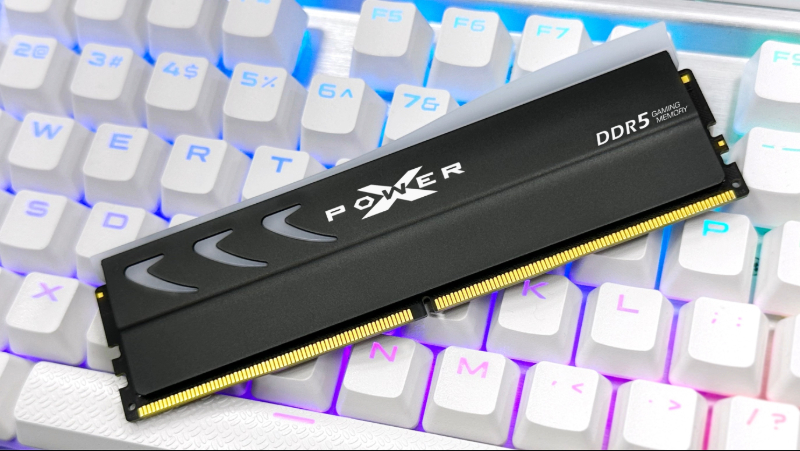
DDR5 features major structural advancements that deliver faster speeds, improved energy efficiency, and lower power consumption.
As AI and big data continue to grow, DRAM (Dynamic Random Access Memory) has advanced to DDR5 to handle rising computational demands. DDR5 offers twice the bandwidth of previous generations, higher capacity, and lower power consumption. It delivers better performance, enhanced stability, and improved energy efficiency, making it perfect for data centers, gaming, and AI workloads. If you enjoy building computers, you may already know DDR5, but what makes this new mainstream memory stand out? This article will break it down for you, taking you deep into the features of DDR5!
Menu
-What is DDR5? The Evolution of DDR Memory
What is DDR5? The Evolution of DDR Memory
DDR5 represents the latest generation of Dynamic Random Access Memory (DRAM) technology. “DDR” stands for Double Data Rate, while “5” denotes the fifth generation. Early DDR debuted in 2000, operating at speeds ranging from 266MT/s to 400MT/s. DDR2 widely supported dual-channel memory configurations, enabling motherboards to transmit data through two channels simultaneously for increased bandwidth; DDR3 introduced power-saving designs, making its low-power characteristics ideal for laptops; DDR4 evolved by incorporating bank groups, improving chip density and design to boost transmission efficiency.
By 2021, DDR5 emerged with a major architectural breakthrough: splitting memory modules into two independent sub-channels, each capable of handling 32-bit data. While the overall data bandwidth remains 64-bit like DDR4, this division into two sub-channels significantly enhances data access efficiency.
Additionally, DDR5 shows significant progress in voltage management. Its modules incorporate a built-in Power Management IC (PMIC), eliminating the need to rely on the motherboard for power supply as DDR4 did. This enables more precise and stable voltage control. If you're curious about DDR5 and want to learn more about its performance features, keep reading!
How Fast Is DDR5? An Introduction to DDR5 Performance
As mentioned earlier, DDR5 memory features major structural advancements that enable faster speeds, improved energy efficiency, and lower power consumption. Let's explore DDR5's performance through its speed and power consumption aspects!
DDR5 Speed
After dividing into independent 32-bit sub-channels, DDR5 achieves a base speed of 4800MT/s. With overclocking technologies like Intel's XMP or AMD's EXPO profiles, speeds can surpass 8000MT/s. The dual-bandwidth design not only boosts speed but also reduces data access latency. Furthermore, DDR5 doubles the number of memory banks from 4 to 8. This increases the amount of data processed simultaneously, enabling memory to respond faster to task execution and further boosting performance.
However, to fully unleash DDR5's high-speed transmission capabilities, compatible hardware is essential. If hardware and memory are incompatible, speeds will be throttled to lower frequencies. Therefore, a computer's motherboard must support DDR5-compliant slots and memory controllers, with optimized data transfer protocols, to truly harness DDR5's performance advantages.
DDR5 Stability and Power Consumption
DDR5 not only achieves higher speeds but also improves power efficiency and stability. First, DDR5 incorporates an On-Die ECC design, where DRAM chips contain additional check bits to detect and correct single-bit errors in real time. Historically, without internal or external ECC protection, prolonged use could accumulate memory errors that sometimes caused system instability or crashes. On-Die ECC corrects internal chip errors before data transmission, significantly enhancing memory stability.
DDR5 features low power consumption with its integrated Power Management IC (PMIC), enabling more efficient energy management and precise voltage control. This enhanced power stability improves memory signal integrity, delivering more reliable overall performance. Additionally, DDR5 operates at 1.1V, down from DDR4's 1.2V, directly reducing power consumption and heat generation. This ensures stable performance under heavy loads, making it ideal for future high-performance applications like AI computing or gaming.
DDR5 vs. DDR4
Clearly, DDR5 delivers substantial performance gains. However, most users still rely on DDR4, and DDR4 and DDR5 are incompatible. If you're planning to purchase a new computer and considering upgrading to DDR5, the following comparison of their differences and advantages will help you make a more informed choice.
| Specification | DDR4 |
DDR5 |
| Bandwidth | Up to 25.6 GB/s | Up to 51.2 GB/s |
| Clock Speed | 2133–3200 MT/s, overclockable up to DDR4-5000 | 4800–6400 MT/s, overclockable beyond DDR5-6800 |
| Single Module Capacity | Up to 32 GB | Up to 128 GB |
| Operating Voltage | 1.2V | 1.1V |
| CAS Latency | DDR4-2133–3200: 13–16; overclocked modules can reach 13 | DDR5-4800: 36–40; DDR5-6400 around 36 |
| ECC (Error Correction Code) | Not built-in, optional depending on design | Built-in On-die ECC |
The comparison reveals that the primary differences between DDR5 and DDR4 lie in clock speed and bandwidth. Compared to DDR4, DDR5 nearly doubles the base clock speed and bandwidth. This upgrade means users experience reduced wait times during multitasking, such as running multiple applications simultaneously, performing data analysis, or conducting real-time computations like AI inference.
For gamers, higher bandwidth reduces CPU wait times for memory access and stabilizes FPS (frames per second) performance, resulting in smoother gameplay and visuals. In data-intensive tasks like video editing and 3D rendering, DDR5 also accelerates data transfer speeds.
Conclusion
In summary, as computational demands grow, especially for AI processing and esports, DDR5 represents the most advanced memory technology. If you are a hardcore gamer, content creator, 3D modeler, or frequently work with AI processing and AI-generated content, DDR5 should be your priority when building a new system. Upgrading to DDR5 can also significantly improve performance on an underpowered PC or laptop. However, when upgrading older systems, always check that your motherboard supports DDR5 to ensure compatibility.
FAQ
• • •